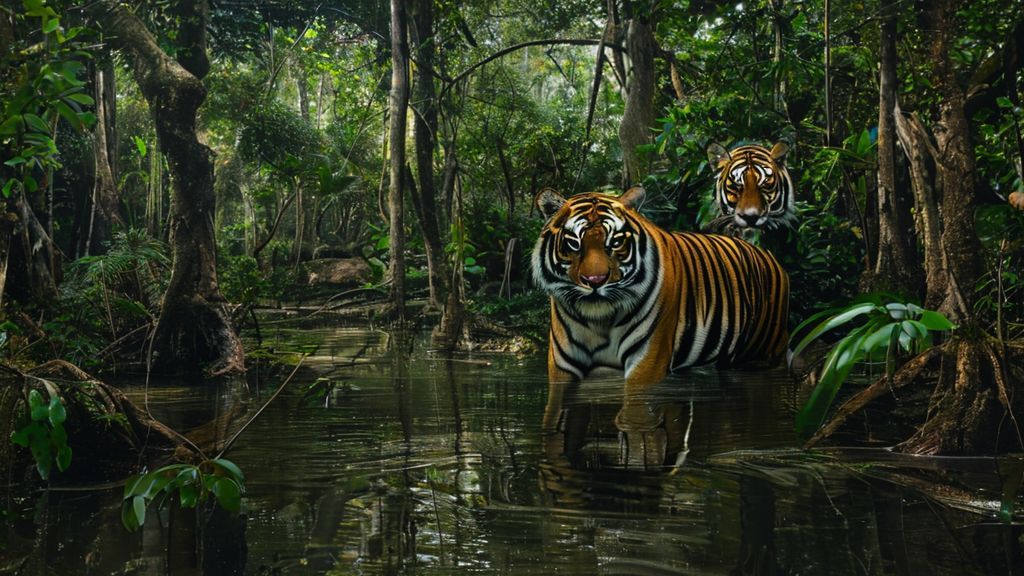
In the Sundarbans, a
Sundarbans Tiger Reserve: Mangrove Mystery and Bengal Tigers
Beyond the whispers of the tides, in a labyrinth where land and sea entwine, reigns a phantom king: the Bengal Tiger of the Sundarbans.
The Emerald Labyrinth’s Genesis: Where Rivers Meet the Sea
The air hangs thick and humid, tasting of salt and damp earth. A low growl, not of beast but of distant thunder, rolls across the vast expanse as the river, swollen and brown, surges past our small boat. Here, the very ground beneath us feels alive, constantly shifting, breathing with the pulse of the tides. This isn’t just a forest; it’s a colossal, living sculpture, painstakingly carved by the relentless will of water.
A Dynamic Delta’s Ancient Heartbeat
Imagine the titanic forces at play: the Ganges, the Brahmaputra, and the Meghna – three of Asia’s mightiest rivers – converging to discharge their colossal loads into the Bay of Bengal. For millennia, they have been architects, tirelessly depositing silt and sediment, grain by grain, to construct the largest active delta on Earth. The Sundarbans, a geographical marvel of staggering proportions, is the dynamic result: a sprawling mosaic of over 10,000 square kilometres, a labyrinthine embrace of islands, narrow tidal creeks, and treacherous mudflats. It is a land born of water, eternally young in geological terms, its inherent fragility underscored by its constant transformation. What was solid ground yesterday might be a shallow channel tomorrow, a testament to nature’s raw, untamed power. To navigate its intricate waterways is to witness creation in an endless, slow-motion ballet.
It is amidst this geological crucible that the unique mangrove ecosystem thrives, a masterpiece of natural adaptation that gives the region its very name: the “Sundari trees” (Heritiera fomes). These aren’t just ordinary trees; they are pioneers, engineers, survivors. Their glossy, leathery leaves sparkle under the sun, a verdant canopy unlike any other. Look closely, and you’ll see their specialised adaptations: the pneumatophores, or “breathing roots,” thrusting upwards like gnarled fingers from the oxygen-deprived mud, desperate gulps of air for the submerged root systems. Then there’s vivipary, a botanical miracle where seeds germinate while still attached to the parent plant, dropping fully formed saplings ready to embed themselves in the soft earth below. And, of course, their incredible salt-tolerance mechanisms, allowing them to flourish where few other plants can, transforming brackish water into life-giving sustenance.
The rhythm of life here is dictated by the moon and the sea. The powerful influence of the daily high and low tides acts as the region’s very heartbeat, sculpting the environment with an unseen hand. Twice a day, the sea reclaims the land, inundating the forest floor, flushing the creeks, and then, just as predictably, retreating to reveal vast stretches of glistening mud. This ebb and flow dictates the life cycles of nearly every inhabitant, from the smallest mudskipper to the largest crocodile, creating a perpetually brackish world that is both challenging and abundant. To stand on a riverbank as the tide turns, watching the water creep up, then recede, is to feel the pulse of an ancient, ongoing creation, a profound wonder at the intricate dance between land and sea.
Whispers of Time: A Human History in the Mangroves
The sun, a fiery orb, dips low, painting the sky in hues of orange and purple, reflecting in the glassy surface of the tidal creek. A lone fisherman, silhouetted against the fading light, casts his net with practiced ease, a scene that has played out here for centuries. The air grows cooler, and with it, the whispers of the past seem to rise from the dense emerald canopy. This wilderness, formidable as it is, has never been entirely devoid of human presence.
Ancient Roots, Colonial Echoes
Long before modern maps charted its serpentine waterways, the Sundarbans was a frontier, a realm of both terror and bounty. Archaeological evidence points to human settlements dating back centuries, suggesting a resilient populace who learned to live by the rhythm of this unforgiving land. These early inhabitants were not conquerors but adapters – hunter-gatherers, fishermen, and collectors who understood that survival here meant becoming an intrinsic part of the ecosystem. They developed unique strategies for navigating the treacherous currents and impenetrable thickets, building their lives on the precarious balance of brackish water and shifting mud. Their reverence for the forest was profound, a blend of fear and deep respect, personifying its dangers and blessings through deities like Bonbibi, the benevolent forest goddess, and Dakshin Rai, the tiger god. Their stories, passed down through generations, speak of a daily dance with the wild, where every step was a gamble and every harvest a blessing.
“The forest gives, and the forest takes,” an old ‘Jele’ (fisherman) once told me in hushed tones, his eyes reflecting the deep wisdom of generations spent battling the tides. “We pray to Bonbibi, for she is our protector, our mother in this wild place.”
During the Mughal period, from the 16th to the 18th centuries, the Sundarbans largely remained an untamed frontier, a vast, wild expanse that served as a natural barrier and a source of occasional resources. Its formidable nature kept large-scale incursions at bay, allowing its unique ecosystem to flourish largely undisturbed. However, with the advent of the British colonial administration in the late 18th century, the perception of the Sundarbans shifted. It was no longer merely a wild hinterland but a valuable resource, particularly for its rich timber. Systematic forest management, driven by economic interests, began to take root. The prized ‘Sundari’ wood, renowned for its durability and resistance to rot, became a prime commodity, eagerly sought for boat building, construction, and fuel. This era marked the beginning of a more structured, albeit extractive, relationship between humans and the Sundarbans, laying the groundwork for the modern-day reserve while simultaneously initiating a period of significant environmental impact. The echoes of axe blows and the creak of timber boats still seem to linger in the deep silence, testaments to a past shaped by both reverence and exploitation.
The Phantom King: Hunting the Bengal Tiger
A shiver, unrelated to the cool morning breeze, runs down my spine. The dense wall of mangroves presses in, its myriad roots weaving an impenetrable barrier at the water’s edge. Our boat drifts silently, the only sound the gentle lapping of water against the hull and the distant cries of unseen birds. This is it. This is the heart of the enigma, the territory of the phantom king. Every rustle of leaves, every splash in the water, amplifies the tension. We are in the realm of the Bengal Tiger, and here, we are the intruders.
Stripes in the Shallows
The Sundarbans tiger is not just any tiger; it is a creature forged by the unique crucible of its environment. Unlike its terrestrial cousins, this apex predator has adapted to a life intimately intertwined with water. Its powerful physique and broad paws make it an exceptional swimmer, effortlessly navigating the swift currents of the tidal creeks, often covering surprising distances in search of prey or new territory. The saline water is not a deterrent but a second home. While they primarily hunt deer and wild boar, the Sundarbans tiger has also developed a more diverse palate, known to occasionally prey on fish, crabs, and even monitor lizards, demonstrating an incredible adaptability that sets it apart. These aren’t just land hunters; they are amphibious assassins, masters of camouflage and stealth in a world of shifting water and dense foliage.
The elusive nature of the Sundarbans tiger is legendary. Years can pass, and even experienced guides might only catch a fleeting glimpse – a ripple in the water, a fresh pugmark in the mud, or the chilling roar that reverberates through the dense forest. This ghost-like presence contributes to both its mystique and its danger. Human-tiger conflict is a stark reality here, a tragic consequence of diminishing habitats and the constant proximity between the lives of the forest dwellers and the apex predator. Local villagers, especially ‘Mouli’ (honey collectors) and ‘Jele’ (fishermen), venture into the tiger’s domain for their livelihoods, often paying the ultimate price. This isn’t just a conservation challenge; it’s a deeply human drama, where survival for both species hangs precariously in the balance. Conservation efforts, like India’s Project Tiger, strive to protect these magnificent creatures, but the threats are relentless: habitat loss due to rising sea levels, increased salinity affecting prey populations, and the ever-present danger of poaching. To witness a Sundarbans tiger, even from afar, is to touch something ancient and wild, a primal force that commands immediate, absolute respect. It is the ultimate testament to nature’s enduring power.
Life in the Shallows: Beyond the Tiger’s Shadow
A kingfisher, a jewel of iridescent blue, darts past our bow, its sharp cry piercing the morning quiet as it plunges into the water, emerging with a silvery prize. The sun is higher now, illuminating the intricate details of the mangrove roots, where crabs scuttle and mudskippers gaze with bulbous eyes. The Sundarbans is far more than just the tiger’s domain; it’s a vibrant, buzzing metropolis of life, a symphony of survival orchestrated by the tides.
A Symphony of Survival
Step beyond the shadow of the phantom king, and an entire universe unfolds. The brackish waters teem with life: the sinister, ancient gaze of saltwater crocodiles lurking beneath the surface, the playful splashes of Gangetic dolphins in the wider river channels, and schools of fish glinting like scattered silver. Above, the canopy is alive with the chatter of Rhesus macaques, their agile forms swinging through the branches, while spotted deer (Chital) graze nervously at the water’s edge, their keen senses constantly alert to danger. Birdwatchers find paradise here, with over 250 species of resident and migratory birds, from the majestic white-bellied sea eagle soaring overhead to the vibrant storks and sandpipers foraging in the mudflats. Every creature, no matter how small, plays a vital role in this intricate food web, a delicate balance that holds the entire ecosystem together.
Yet, it is the human inhabitants who add another compelling layer to this tapestry of life. The ‘Mouli’, with their faces smeared with mud to ward off bees, brave the dense forests in small groups, their lives dependent on the sweet harvest of wild honey. The ‘Jele’, skilled fishermen, navigate the treacherous creeks in their slender boats, their nets cast in hope and prayer. And the ‘Baoli’, the woodcutters, who sparingly and sustainably extract timber for local use, understand the forest’s limits. Their existence is a daily testament to resilience, a constant negotiation with the wild. They live by an unwritten code of respect and fear, their faith deeply intertwined with the protective powers of Bonbibi, whose shrines are found scattered throughout the villages, a beacon of hope against the ever-present dangers.
“When we go into the forest, we carry our prayers,” a grizzled ‘Mouli’ shared, his weathered hands tracing patterns in the air. “Bonbibi protects us from the tiger, from the snakes, from the storms. Without her, there is no honey, no fish, no life.”
To travel these waterways is to witness this profound interconnectedness, to see the sheer tenacity of life in an environment that demands constant adaptation. It’s a reminder that true wilderness isn’t just about grand predators, but about the million small lives that create its pulse, each contributing to the grand, dangerous, beautiful symphony of the Sundarbans.
The Tides of Change: Facing Tomorrow’s Challenges
The boat cuts a furrow through the water, leaving a shimmering wake that quickly dissipates into the vastness. But the tranquility is deceptive. Beneath the surface, and in the unseen currents of global change, a profound struggle is unfolding. The Sundarbans, a jewel of biodiversity, stands at the forefront of an environmental crisis, its very existence threatened by forces far beyond its control.
A Fragile Future
The Sundarbans is a sentinel, a living barometer of our planet’s health, and its prognosis is increasingly concerning. As a low-lying delta, it is acutely vulnerable to the impacts of climate change, particularly sea-level rise. Scientific projections indicate that even a modest increase in sea levels could inundate significant portions of the reserve, washing away entire islands, shrinking vital tiger habitat, and contaminating freshwater sources with increased salinity. This rising tide doesn’t just threaten land; it threatens life itself, altering the delicate balance of the mangrove ecosystem, impacting the availability of food for both wildlife and human communities.
The frequency and intensity of cyclones have also increased, battering the fragile coastline with destructive force, uprooting mangroves that act as natural barriers, and further eroding the land. These natural disasters, exacerbated by a warming planet, leave a trail of devastation that the ecosystem struggles to recover from, pushing species and communities further to the brink. It’s a stark reminder that the Sundarbans is not an isolated wilderness, but a globally significant ecosystem whose fate is intertwined with the choices made far beyond its emerald labyrinth.
Yet, amidst these daunting challenges, there is hope, woven into the fabric of dedicated conservation initiatives. India’s Project Tiger, a landmark conservation program, continues its vital work in the Sundarbans, focusing on habitat protection, anti-poaching measures, and scientific research to understand and mitigate threats. Crucially, there’s a growing emphasis on community involvement. Local populations, who live at the frontline of human-wildlife conflict and climate change, are becoming integral partners in conservation efforts. Initiatives that promote sustainable livelihoods, offer alternative income sources, and educate about the importance of mangrove protection are slowly empowering communities to become guardians of their own environment.
“The Sundarbans is our home, our life,” a young ranger passionately articulated, his gaze sweeping across the vast expanse. “If we protect it, it protects us. It is a lesson for the whole world.”
The Sundarbans is more than a tiger reserve; it is a global heritage site, a natural fortress against the sea, a unique genetic repository, and a living laboratory for survival. Its future hangs in the balance, a testament to humanity’s collective responsibility to protect the planet’s most extraordinary places. To preserve this mangrove mystery and its phantom king is not just about saving a species; it is about safeguarding a unique ecosystem that offers invaluable lessons in resilience, adaptation, and the profound, undeniable interconnectedness of all life on Earth.
As the setting sun bleeds into the horizon, casting long, fractured shadows across the water, the Sundarbans begins to stir with the nocturnal symphony of its hidden inhabitants. The air, thick with the scent of damp earth and blooming mangroves, carries the faint, unsettling calls of creatures unseen. This emerald labyrinth, a testament to nature’s relentless power and delicate balance, is a place that seeps into your soul, changing you with its primal energy. It’s a reminder that true wilderness still exists, untamed and magnificent, demanding our awe, respect, and unwavering protection. To leave the Sundarbans is to carry a piece of its mystery within you, a silent promise to remember the phantom king and the fragile, vibrant world he reigns over, where every tide brings a new story and every root holds a secret.