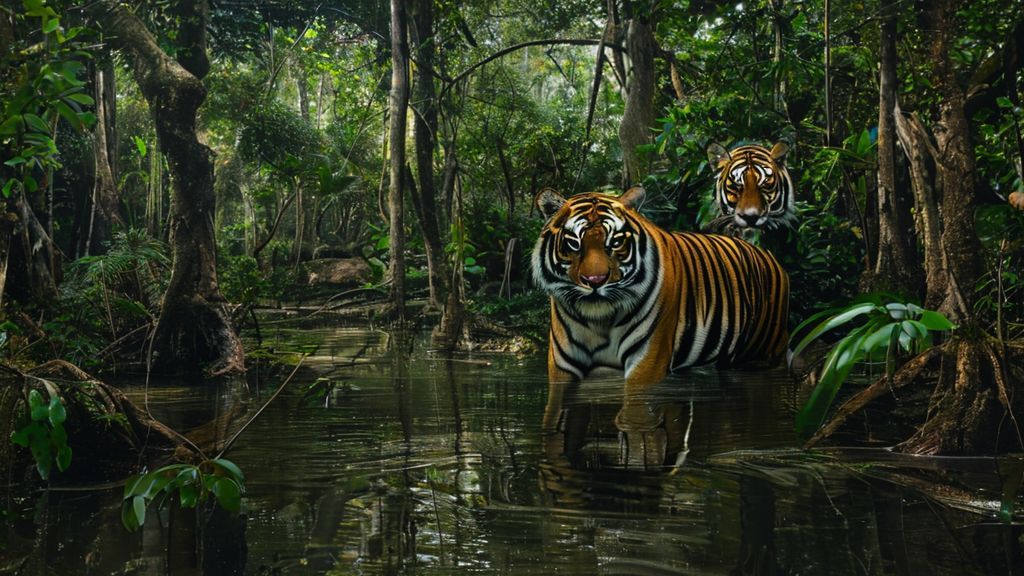
Welcome to the Sundarbans, where
Imagine a place where the land breathes with the tides, where ancient rivers surrender to the sea, and where the most magnificent predator on Earth swims silently through a labyrinth of green – welcome to the Sundarbans.
1. Introduction: Where Land Dissolves into Legend
The sun, a molten disc, dipped below the horizon, painting the sky in fiery streaks of orange and purple. Our small wooden nauka, a traditional boat, glided through water that shimmered like liquid bronze, the only sound the soft lap of the tide against the hull and the distant call of an unseen bird. Around us, the world was a seamless tapestry of emerald green – the dense, impenetrable mangrove forest of the Sundarbans. This wasn’t just a destination; it was an ingress into a legend, a journey into the heart of a living paradox.
The Sundarbans Tiger Reserve is not just a place; it’s a living, breathing enigma, a testament to nature’s raw power and delicate balance. It’s where the mighty Ganges, Brahmaputra, and Meghna rivers surrender their freshwater to the saline embrace of the Bay of Bengal, creating the world’s largest contiguous mangrove forest – a UNESCO World Heritage site and a wonder of the natural world. Here, the very land seems to dissolve into water, an intricate, emerald labyrinth where every shadow holds a secret. This is the last bastion of the Royal Bengal Tiger, the undisputed monarch of this aquatic jungle, whose unseen presence pulses through the very roots of the mangroves. To step into the Sundarbans is to enter a sacred, wild realm, where the whispers of the wild carry the weight of ancient tides and the raw, untamed power of nature reigns supreme. It’s a place that demands not just observation, but reverence, a deep, abiding awe for a world delicately balanced between survival and struggle.
2. The Labyrinthine Embrace: A World Forged by Water
Where Rivers Meet the Sea, and Life Finds a Way
The morning mist clung to the water, blurring the lines between river and sky, creating an ethereal landscape that felt more dreamt than real. As our boat pushed deeper into the narrow creeks, the dense canopy of mangroves closed in, forming a verdant tunnel. The air, thick with the smell of salt, mud, and decaying leaves, was a constant reminder of the primal forces at play here. This isn’t land as we know it, firm and unyielding; it’s a fluid, ever-shifting canvas, sculpted by the relentless rhythm of the tides.
Here, three of the subcontinent’s greatest rivers – the Ganges, Brahmaputra, and Meghna – converge, their colossal freshwater flows meeting the saline embrace of the Bay of Bengal. This epic confluence has birthed a landscape unlike any other: a sprawling delta system crisscrossed by thousands of tidal waterways, mudflats, and small islands. The mangroves themselves are nature’s most extraordinary architects, a living fortress of trees like the Sundari (from which the Sundarbans likely derive its name) and Goran, their unique aerial roots, called pneumatophores, reaching skyward like gnarled fingers. These roots are not merely anchors; they are breathing tubes, allowing the trees to extract oxygen from the air in waterlogged, anaerobic soil. They are nature’s intricate plumbing system, filtering pollutants, stabilizing the delicate soil, and creating a nursery for countless marine species. The constant ebb and flow of the tides—a dramatic rise and fall of several feet twice daily—constantly reconfigures the landscape, swallowing and revealing islands, deepening some creeks, silting others. This dynamic, relentless cycle of inundation and exposure defines every living thing within this watery world, pushing all life to adapt, to evolve, to find a way to thrive against incredible odds. It’s a place that can feel disorienting, overwhelming in its sheer scale and complexity, yet utterly fascinating in its ingenious design.
Place a stunning wide-angle photograph of the Sundarbans waterways at sunset or sunrise, showcasing the dense mangroves and the reflections on the water.
3. Shadows of the Sundarbans: The Royal Bengal Tiger’s Realm
The Apex Predator of the Aquatic Jungle
A sudden, sharp cry of a Spotted Deer ripped through the afternoon stillness, followed by an immediate, profound silence. Every head on our boat snapped towards the dense wall of mangroves. Our guide, his eyes narrowed, held a finger to his lips. We waited, breathless, for what felt like an eternity. Nothing. Only the slow, steady drip of water from the leaves and the thumping of our own hearts. It was a stark reminder of the unseen presence that truly rules this domain.
In the Sundarbans, the Royal Bengal Tiger is not just an animal; it is the very soul of the forest, an almost mythical being whose existence imbues every rustle of leaves, every ripple in the water, with a heightened sense of drama. Majestic, powerful, and notoriously elusive, these tigers are unlike any other. They are master swimmers, navigating the labyrinthine creeks with a grace that belies their immense size. Their paws, unusually broad, act like paddles, propelling them silently through the brackish waters where they hunt not just deer and wild boar, but also fish, crabs, and even monitor lizards. They are supremely adapted to this saline, tidal environment, their bodies capable of tolerating the constant shifts between fresh and salt water. We longed for a glimpse, just one flash of their fiery orange and black stripes, but the Sundarbans tiger is a ghostly guardian, often felt more than seen. Their rarity only magnifies their mystique; to spot one is considered an almost spiritual experience, a testament to immense patience and luck. The “man-eater” reputation, while terrifying, is often a tragic consequence of habitat overlap and the scarcity of prey in a shrinking world, adding a layer of primal fear and respect that only deepens their legend. More than just a predator, the tiger is a critical indicator species; its health and survival are inextricably linked to the health of the entire Sundarbans ecosystem. Without the tiger, this unique world would lose its wild heart.
“In the Sundarbans, the tiger is not just an animal; it is the spirit of the forest, a living legend that commands respect and embodies the wild heart of this unique ecosystem.”
4. Whispers of the Past: A History Drowned in Tides
Legends, Outlaws, and Empires in the Mangrove Maze
We pulled our boat close to a small, eroded island, its muddy banks scarred by the tides. Our guide pointed to a patch of overgrown ruins, barely discernible amongst the roots. “Here,” he murmured, “they say a king once tried to build. The forest, she always wins.” The air hung heavy with the weight of forgotten tales, of human ambition met with nature’s relentless power.
The history of the Sundarbans is as ancient and layered as its muddy riverbanks, a saga of human ambition, resilience, and ultimate surrender to the forces of nature.
Ancient Times (Pre-Mughal): For centuries, the Sundarbans remained largely untamed, a formidable natural barrier and a refuge for outlaws, pirates, and those seeking escape from mainland rule. Imagine a time when these waterways teemed with brigands, their small boats darting through the creeks, preying on unsuspecting traders. Legends speak of a lost city, Bagerhat, once a thriving metropolis, now largely swallowed by the encroaching tides, hinting at earlier, more ambitious human attempts to settle this challenging terrain. The dense mangroves were considered the domain of spirits and wild beasts, a fearsome wilderness largely untouched by large-scale human intervention, a place where hermits sought solitude and the brave ventured only out of desperation.
Mughal Era (16th-18th Century): The mighty Mughals, with their vast empire, made some attempts to assert control over the Sundarbans, primarily for revenue collection and timber extraction. However, their efforts were largely unsuccessful. The challenging, ever-shifting terrain, coupled with the fierce wildlife and the constant threat of tidal surges, proved too formidable. While some limited human settlements sprang up on the fringes, the core of the Sundarbans remained largely wild, a testament to its untamable spirit. Expeditions for valuable timber were perilous undertakings, often ending in tragedy, further cementing the region’s reputation as a dangerous, mystical place.
British Colonial Period (18th-20th Century): With the arrival of the British, a more systematic approach to the Sundarbans began. They initiated extensive mapping efforts, slowly charting the bewildering network of waterways. Resource extraction intensified, with large-scale timber felling for ship-building and construction, alongside the collection of honey and beeswax. While their primary motivation was economic, these efforts also led to the establishment of the first forest divisions and a nascent recognition of the region’s unique ecological value. Early conservation efforts, though often driven by resource management rather than pure ecological preservation, marked the dawn of organized oversight in this wild frontier. Yet, even with modern tools, the British struggled against the sheer power of the environment and its dominant predator, the tiger.
Post-Independence: Following the partition of India and the independence of Bangladesh, dedicated conservation efforts truly took root. The establishment of the Sundarbans National Park and Tiger Reserve in India, and its counterpart in Bangladesh, marked a critical shift. The focus moved from mere resource extraction to dedicated protection of its unparalleled biodiversity, particularly the Royal Bengal Tiger, recognizing its global significance. It was a turning point, striving to protect what centuries of human ambition had failed to conquer.
Key Historical Milestones
- Lost City of Bagerhat: A testament to nature reclaiming its own.
- Pirate Havens: Where outlaws found refuge from empires.
- Mughal Timber Expeditions: Early, often perilous, attempts to tame the wild.
- British Forest Divisions: The dawn of organized resource management and mapping.
5. Beyond the Tiger’s Gaze: A Symphony of Survival and Struggle
The Rich Tapestry of Life and the Human Element
As our boat navigated a wider channel, the forest seemed to open up, revealing more of its vibrant, tenacious life. A sleek estuarine crocodile, ancient and unmoving, basked on a muddy bank, its eyes like chips of amber. Overhead, a flurry of kingfishers, their plumage a riot of electric blue and emerald, darted into the water. Further on, a herd of Spotted Deer, their coats dappled like sunlight through leaves, grazed cautiously near the water’s edge, ever-vigilant. This world is a symphony, where every creature plays a vital role, a constant dance of survival.
Beyond the magnetic allure of the Royal Bengal Tiger, the Sundarbans teems with an astonishing array of biodiversity. Its brackish waters are home to monstrous estuarine crocodiles, whose ancestors have patrolled these channels for millions of years, and the elusive Gangetic dolphin. The dense undergrowth harbors venomous snakes like the King Cobra and Russell’s Viper, alongside monitor lizards and a fascinating array of amphibians. The skies are a birdwatcher’s paradise, with a kaleidoscope of species from vibrant kingfishers and graceful egrets to formidable white-bellied sea eagles circling high above. Each species, from the tiniest mudskipper to the largest raptor, has adapted in extraordinary ways to this unique, challenging habitat.
Yet, this wild paradise is not uninhabited. On its fringes, brave communities of people – the Mawalis (honey collectors), Bawalis (woodcutters), and resilient fishermen – have carved out a precarious existence for centuries. Their lives are interwoven with the forest, a symbiotic yet perpetually dangerous relationship. They possess an intimate knowledge of the tides, the currents, and the forest’s subtle signs, passed down through generations. I remember watching a group of fishermen mend their nets, their hands moving with practiced ease, their eyes constantly scanning the water, a quiet vigilance against the ever-present threat of the bagh, the tiger. Their courage is humbling, a stark reminder of humanity’s enduring connection to the wild, even when it demands the ultimate price.
But this delicate balance is under immense threat. The Sundarbans, a low-lying delta, is one of the most vulnerable regions on Earth to the impacts of climate change. Rising sea levels are steadily encroaching, swallowing islands, increasing the salinity of the water, and destroying vital habitats. The frequency and intensity of devastating storm surges are escalating, tearing through communities and reshaping the landscape with brutal force. Habitat degradation from human encroachment, pollution, and the relentless pressure of a growing population further exacerbates the human-wildlife conflict, pushing both tigers and people to their limits. Organizations, both local and international, are tirelessly working on conservation efforts, from tiger monitoring and anti-poaching patrols to community-based initiatives that promote sustainable livelihoods and mangrove reforestation. The challenges are monumental, yet the resilience of both nature and humanity in the Sundarbans offers a sliver of hope, a testament to the enduring spirit of this magnificent, struggling ecosystem.
Insert a photograph showcasing other wildlife (e.g., a crocodile basking, a herd of spotted deer, a vibrant kingfisher) or a respectful image of local community members engaged in traditional activities.
CLOSING
The Sundarbans Tiger Reserve is more than just a sanctuary; it’s a living paradox, a place of breathtaking beauty and inherent danger, where the relentless rhythm of the tides sculpts both land and life. It is a world where the ancient whispers of the mangroves mingle with the unseen prowl of the Royal Bengal Tiger, a testament to nature’s untamed power and astonishing adaptability. To experience the Sundarbans is to confront the raw majesty of creation, to feel the pulse of a truly wild heart, and to understand the urgent, profound responsibility we all share in protecting this invaluable, enigmatic realm for generations to come. It leaves you with a profound sense of wonder, a touch of awe-inspired fear, and an enduring respect for a place where land dissolves into legend, and the wild still reigns supreme.